Strategy 9 Update bicycle and micromobility parking practices to support demand and diversity of vehicles to significantly expand bicycle racks in the right of way.
The actions within this strategy are divided into two categories:
Action we will DOActions we will SUPPORTAction we will do are followed by “DO” and are colored in dark gray, and actions we will support are followed by “SUPPORT” and are colored in light gray.
Learn more about how we get thereThe rise of different types of vehicles, including scooters, bikeshare, and other new vehicle types increase the need for safe spaces to park these vehicles. The City currently operates five accommodations for bike and micromobility parking:
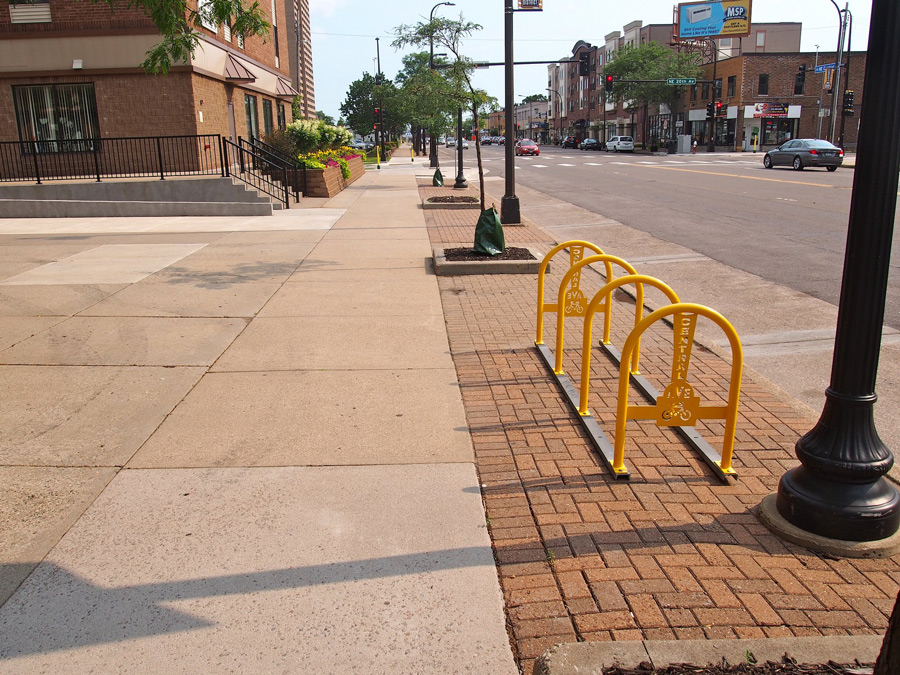
- Bike rack program – The Bike Rack Cost Share program allows eligible businesses to be reimbursed up to 50% of the bicycle rack cost and 50% of the installation cost. Schools, libraries, parks, and other eligible public facilities can request to receive racks at no cost.
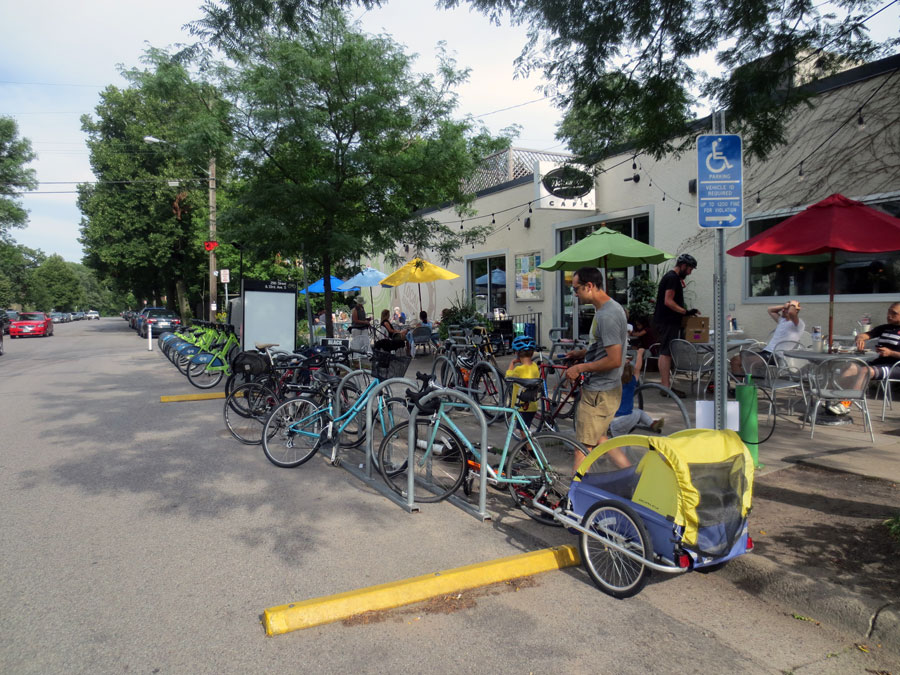
- Bike corral program – The Bicycle Corral Cost Share Program is designed for businesses with high bicycle demand and limited space in the boulevard or sidewalk area. It is a low-cost method to provide bicycle parking in the same space occupied by an on-street parked car. Businesses are reimbursed up to 50% of the bike corral cost.
- Bike lockers – As of 2020, Public bike lockers are available to rent at Ramp A, Courthouse Ramp, the University of Minnesota and at Metro Transit stations and transit centers.
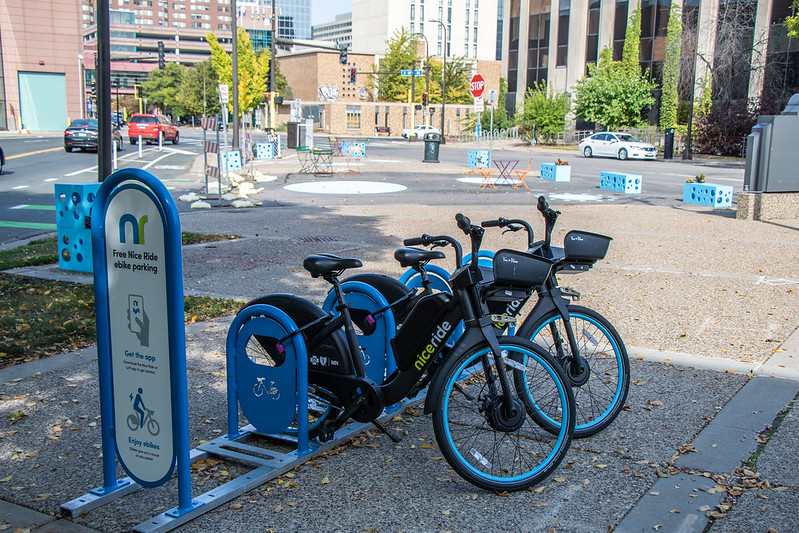
- Bike sharing placement – Nice Ride, which ceased operations in 2022, had both stations for docked bicycles and for dockless pedal-assist ebikes. As of 2025, bike sharing providers have vehicles available throughout the city, with dedicated racks in key locations.
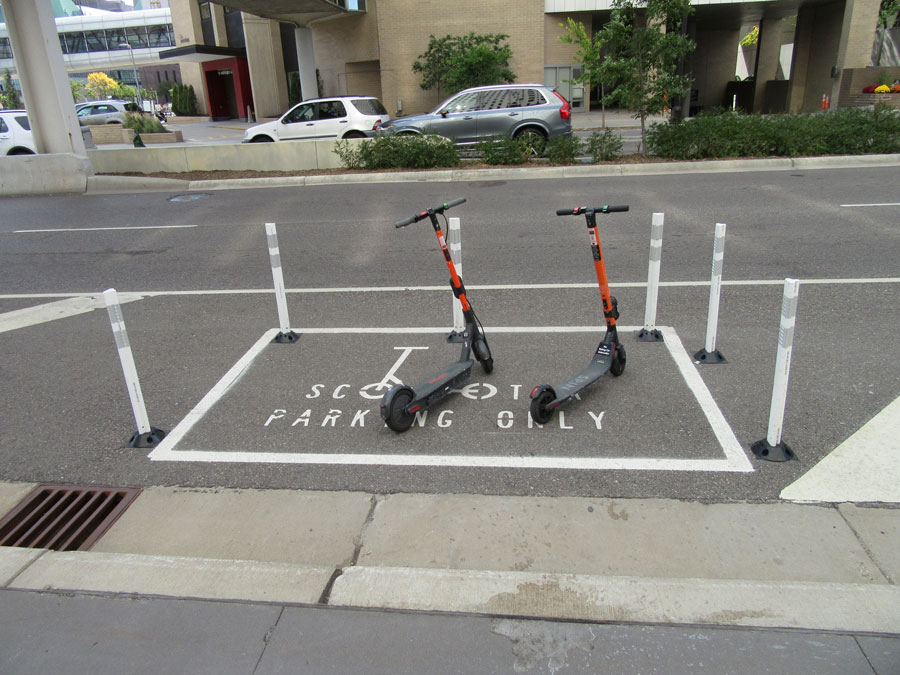
- Scooter parking zones – As of 2020, the City had created several on-street scooter parking zones to provide a designated space for scooters to be parked, out of the pedestrian clear zone and in a predictable manner for scooter users. As of 2025, these parking zones are no longer deployed as scooters are required to be parked and locked to an object such as a bike rack, parking meter hitch, or most city street signs. The latest scooter parking rules are found on the City website.
Actions to update bicycle and micromobility parking practices to support demand and diversity of vehicles to significantly expand bicycle racks in the right of way.
Bicycling 9.1
Develop approach and criteria to reserve curbside or furnishing zone space on all mixed-use block faces for seasonal on-street bicycle and micromobility parking at no charge.
Supported goals:
Equity Mobility
Related actions:
Technology 2.1, Operations 5.11
Difficulty:
Medium
Timeframe:
2020-2023 (years 0-3)
Status:
In Progress
Significant milestone(s):
Public Works is piloting criteria for reserving curbside furnishing space for seasonal use. Market conditions have led to increased costs for seasonal use; permanent and semi-permanent infrastructure and bike parking is preferred. A pilot of on-street micromobility parking corrals is taking place in 2025-2026.
Bicycling 9.2
Complete a citywide evaluation of bike rack installations and develop a process to identify locations to add bike racks across the city, including adding hitches to meter poles and stand-alone bike racks.
Supported goals:
Mobility
Related actions:
Difficulty:
Medium
Timeframe:
2020-2023 (years 0-3)
Status:
Complete
Significant milestone(s):
After inventorying all bike rack locations, Public Works established a process to prioritize additional or improved bike parking infrastructure locations. Using this process, Public Works installed 1,500 meter hitches in 2020, increased racks at mobility hubs, and piloted stop sign hitches in the Lowry Hill East neighborhood in 2024.
Bicycling 9.3
Install bike and micromobility parking with all capital projects, consistent with the Street Design Guide.
Supported goals:
Equity Mobility
Related actions:
Design 1.1, Design 1.2, Design 1.3, Design 1.4, Design 1.5, Design 1.6, Design 1.7
Difficulty:
Low
Timeframe:
2020-2023 (years 0-3)
Status:
Successfully completed to date and on-going
Significant milestone(s):
The Minneapolis Street Design Guide (SDG) has been updated to require bicycle and micromobility parking for all capital street projects. The SDG includes guidance for bicycle parking locations to maintain clear zones for pedestrians and other uses.
Bicycling 9.4
Expand the existing bicycle rack cost share and bicycle corral programs to make free for businesses and residences within Transportation Equity Priority areas.
Supported goals:
Equity Mobility
Related actions:
Difficulty:
Low
Timeframe:
2024-2027 (years 4-7)
Status:
Complete
Significant milestone(s):
The bicycle rack cost share program was updated to fully fund all requests in TEP areas 1 and 2. Public Works is identifying ways to encourage program utilization and update program standards to improve its benefit.
Bicycling 9.5
Update the Zoning Code, which requires minimum bike parking for new developments, to accommodate increased demand and a range of vehicle types, including adaptive and cargo bicycles and electric charging needs.
Supported goals:
Equity Mobility
Related actions:
Technology 6.6
Difficulty:
Low
Timeframe:
2020-2023 (years 0-3)
Status:
Complete
Significant milestone(s):
In May 2021, minimum bicycle parking requirements were updated to apply to more uses and in most cases were increased. The minimums were also changed to apply more consistently citywide. A significant increase was made to requirements for bicycle parking spaces, lockers, and showers for larger non-residential developments and this requirement was expanded past the downtown area to the whole City. Standards were updated to acknowledge the need for e-bike charging, and for making sure at least some spaces (particularly long-term spaces) are accessible to all users.
Bicycling 9.6
Work with Metro Transit to implement secure and covered bicycle parking at transit stations.
Supported goals:
Safety Mobility Active Partnerships
Related actions:
Transit 5.1, Transit 5.2
Difficulty:
Medium
Timeframe:
2020-2023 (years 0-3)
Status:
Successfully completed to date and on-going
Significant milestone(s):
Public Works continues to partner with Metro Transit to explore options for secure and covered bicycle parking at transit stations during project development. Covered bicycle parking was included at the I-35W & Lake Street Station.
See also actions:
- Technology 2.4
Provide adaptive shared vehicles - Technology 6.2
Electric charging infrastructure is compatible with bicycles and micromobility - Street Operations 5.1
Develop curbside management policy